Integration-Segregation Trade-off
Research on how dynamic functional brain networks balance efficient information spreading with segregation under constrained connection costs.
Research question
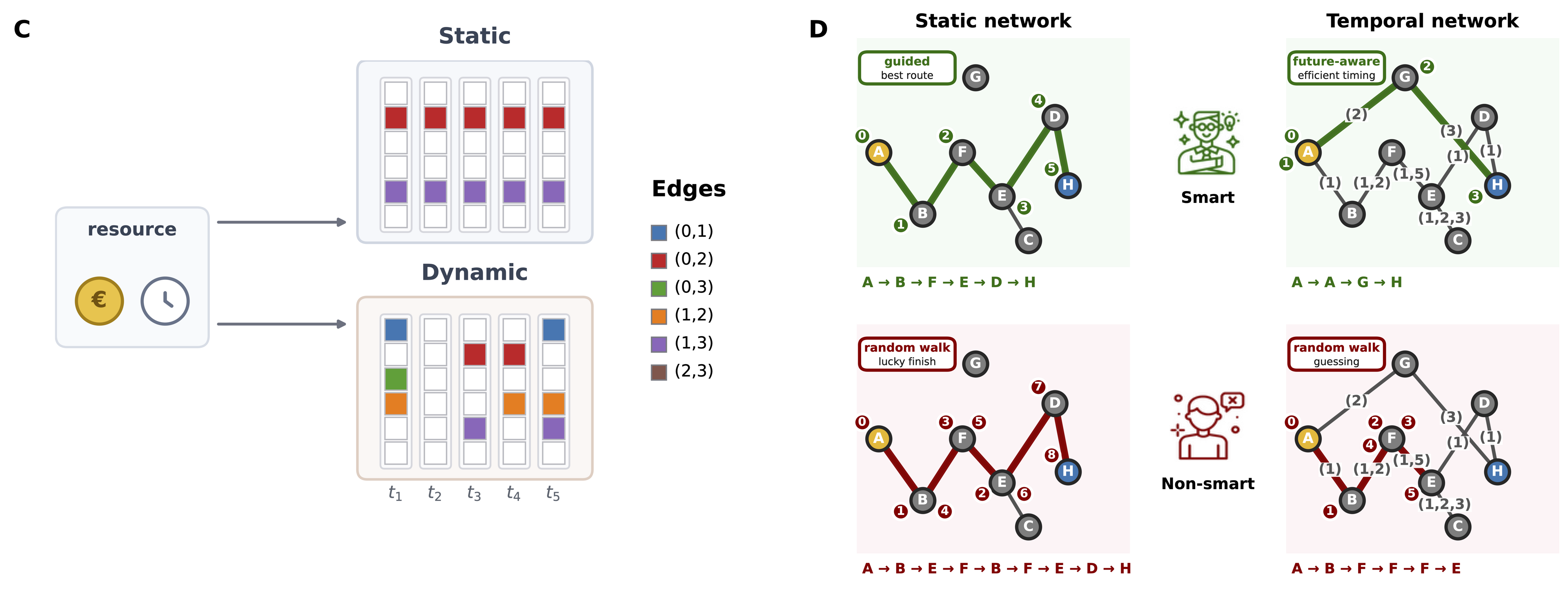
Determine whether time-varying functional connectivity offers an information-processing advantage over static networks built with the same total connection cost.
Data and comparison
The study analyzes dynamic functional connectivity reconstructed from Human Connectome Project fMRI data. Empirical temporal networks are compared with equal-cost static representations and network null models to separate effects of topology from effects of timing.
Analytical approach
Information-spreading measures quantify temporal reachability and transport efficiency, while complementary measures track local organization, temporal clustering, return behavior, and retention. Together they test integration and segregation within the same cost-constrained framework.
Main finding
The analysis indicates that empirical brain-network dynamics combine rapid information spreading with persistent local organization, resolving an apparent trade-off between integration and segregation.
Tools and methods
- Python
- Human Connectome Project
- Dynamic functional connectivity
- Temporal networks
- Network null models
- Information diffusion