Temporal Network Analysis Toolkit
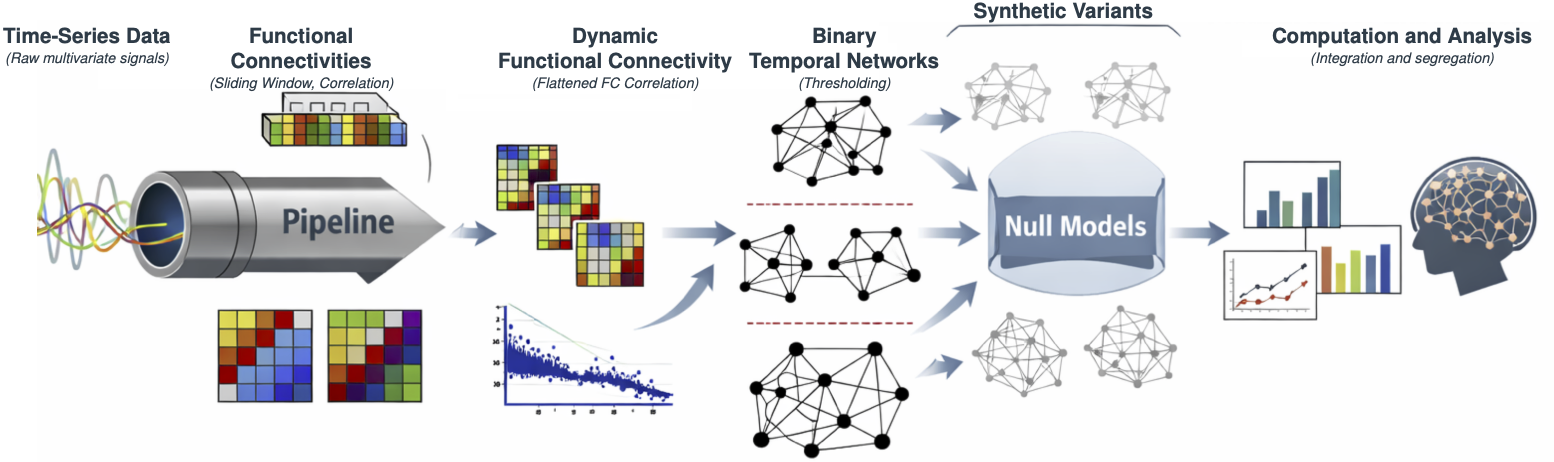
Maintained toolkit for constructing, simulating, and analyzing temporal networks, with documented measures of integration, segregation, reachability, and dynamism.
Problem
Provide a unified framework for transforming time series into temporal networks and quantifying integration, segregation, and temporal memory.
Approach
The toolkit is organized as a modular pipeline for temporal network analysis. It supports conversion from time series to temporal graphs, generation of synthetic and null temporal networks, and a broad set of analytical measures spanning reachability, dynamism, and structure.
Each functional group is designed to be composable, allowing users to mix empirical data, null models, and analysis routines without restructuring the pipeline.
Core components
- Time series → temporal network construction
- Synthetic and null temporal network generators
- Temporal distance, reachability, and circulation metrics
- Dynamism and temporal memory measures
- Segregation, cohesion, and community persistence metrics
Impact
Provides optimized, composable analysis workflows for empirical and synthetic temporal networks, with updated measure names and full user documentation.
Tools and Methods
- Python
- Temporal networks
- Dynamic functional connectivity
- Graph algorithms
- Random walks
- Information-theoretic metrics